Your Car's Fuel Gauge Is a Pathological Liar and You Keep Believing It
The Great Deception Begins
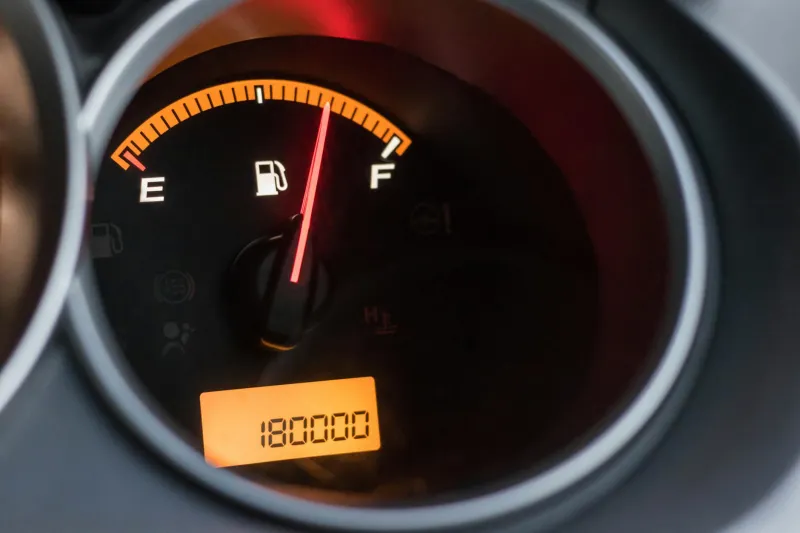
Somewhere between your house and literally anywhere else, your fuel gauge transforms from a helpful measurement tool into a compulsive liar with commitment issues. That needle hovering just above E? It's not indicating "empty"—oh no, that would be too straightforward. Instead, it's whispering sweet nothings about how you've got "totally enough gas" and "probably like 30 miles left, easy."
You know this is nonsense. You've been here before. Yet here you are, nodding along like your dashboard is a trusted financial advisor instead of a collection of plastic and circuits that once convinced you that you could definitely make it to Target and back without stopping.
The Mental Mathematics Olympics
Once that warning light flickers on, your brain immediately enrolls in an advanced calculus course you never signed up for. Suddenly, you're calculating fuel efficiency with the precision of a NASA engineer, factoring in variables like "but I'm mostly going downhill" and "the wind is behind me today."
You start making deals with the universe. If you drive exactly 47 mph, avoid all air conditioning, and somehow reduce your car's weight by thinking lighter thoughts, you can absolutely stretch those remaining fumes into a cross-country road trip. The fact that you failed basic algebra in high school becomes irrelevant when you're running on automotive fumes and pure optimism.
The Cheaper Gas Station Gambit
Why fill up at the perfectly functional station right here when there's definitely a cheaper one somewhere in the general direction you're headed? This is when your inner economist emerges, the same person who clips coupons for items you don't need but suddenly becomes a fuel pricing expert.
You'll drive an extra twelve miles to save four cents per gallon, burning more gas than you'll save, but feeling intellectually superior to all those suckers paying full price back at the convenient location. It's not about the money—it's about the principle. The principle of making terrible decisions while feeling incredibly smart about them.
The Warning Light Negotiation Phase
That little orange light isn't a warning—it's the opening move in a complex negotiation. You've entered into a business relationship with your fuel system, and both parties are terrible at communication.
The light says: "Hey, maybe consider getting gas soon."
You hear: "You've got at least 47 miles, possibly more if you believe in yourself."
This is when you start talking to your car like it's a nervous horse that needs encouragement. "Come on, girl, we've done this before. Remember that time we made it all the way to Mom's house on nothing but hope and two tablespoons of premium unleaded?"
The Psychological Breakdown at Mile Marker 23
There comes a moment—usually at a red light approximately three miles from your destination—when the full weight of your poor decision-making crashes down like a poorly balanced grocery bag. Your car isn't making any unusual noises, but you're convinced you can hear it wheezing.
This is when you start bargaining with deities you don't even believe in. "Please, universe, if you get me to that Shell station, I promise I'll never let it get below a quarter tank again." You've made this exact promise seventeen times this year, but this time you really mean it.
Your palms get sweaty. Not because you're actually in danger, but because the possibility of having to call someone for help means admitting that you voluntarily drove around for three days with a fuel gauge that looked like it was auditioning for a limbo contest.
The Ceremonial Relief
Finally pulling into a gas station on what can only be described as fumes, good intentions, and the automotive equivalent of thoughts and prayers feels like winning the lottery. You've beaten the system once again through a combination of reckless optimism and dumb luck.
As you fill up your tank, you experience a brief moment of clarity. You swear you'll never let this happen again. You'll be responsible. You'll fill up at half a tank like a reasonable adult who makes sensible choices.
Then you see the total on the pump display and immediately start calculating how far you can drive on a full tank, wondering if you really need to fill it all the way up. After all, you've got excellent gas mileage, and there's probably a cheaper station somewhere down the road.
The cycle begins anew, because apparently, your relationship with your fuel gauge is the most toxic thing in your life, and you're both perfectly happy to keep it that way.