The Thirty-Second Geopolitical Summit That Happens Every Time You Try to Get on the Highway
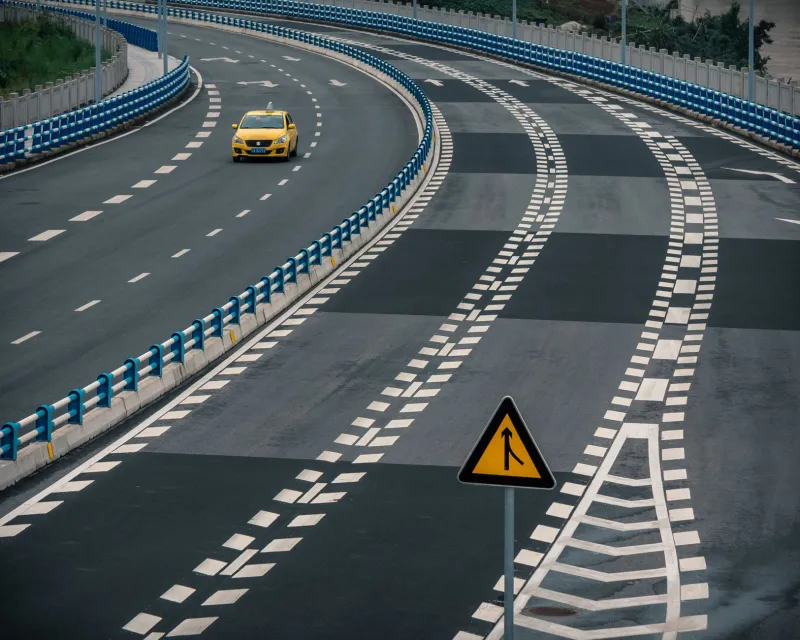
There is no driver's ed class that prepares you for this. The written test does not cover it. The instructor sitting in your passenger seat during your road test never once addressed the complex web of unspoken obligations, silent agreements, and mutual betrayals that govern the act of merging onto the highway.
And yet here you are. Every single day. Navigating it.
The on-ramp stretches ahead of you. Traffic on the highway is moving. You are accelerating, matching speed, doing the math in real time. And somewhere in the lane to your left, a stranger in a vehicle you will never see again is about to become the most significant person in your immediate life.
The Opening Gambit
The negotiation begins before anyone makes a move. You are watching them. They are watching you — or they should be, though there is a non-trivial chance they are watching literally anything else. You have approximately four seconds to read the situation and determine the entire social contract that will govern the next half-mile of your existence.
Are they going to let you in? The signs are ambiguous. They have not slowed down, which is either an invitation or a declaration of war. They have not sped up, which is either good faith or distraction. You glance over. They are looking forward. You are looking at them looking forward. Nobody is making direct eye contact, because direct eye contact at highway speed is a level of intimacy nobody signed up for.
You inch forward. They do not react. You inch forward again. Still nothing. This is either a green light or a test of nerve, and you are not sure which, and you have about two seconds to decide.
The False Start
You go for it.
You commit to the merge. You signal — because you are a person who signals, you are doing everything correctly — and you begin to move left. And the exact moment you do, the car behind them, which you had completely forgotten existed, speeds up and fills the gap.
You retreat. Back to the right. Back to the on-ramp lane, which is running out. Your heart rate has spiked for reasons that are technically disproportionate to the stakes, but your body does not know that. Your body thinks you just narrowly avoided something.
You take a breath. You recalibrate. New gap. New candidate. The whole process starts again from the beginning, except now you are slightly behind the curve and the on-ramp is definitely ending and you can feel the dotted white line about to become a solid white line and you cannot still be on this on-ramp when that happens.
The Eye Contact
Somewhere in the chaos, you make eye contact with a driver. Real eye contact. The kind that lasts long enough to mean something.
In that fraction of a second, an entire conversation happens. You are asking. They are considering. You are grateful. They are deciding whether to be generous. Time slows down in the specific way it only slows down in parking lots and on-ramps, places where the stakes feel enormous and the speeds are technically low.
They tap their brakes. The gap opens. You go.
You are in. You are on the highway. You are safe.
The Wave You Owe
Now comes the ritual. The thank-you wave. This is non-negotiable. This is not optional. The thank-you wave is the social currency that keeps the entire system running, and failing to deliver it is the kind of thing that sits badly with you for longer than it should.
But the logistics of the thank-you wave are more complicated than they appear. You need to do it quickly enough that they can still see it, but not so quickly that it looks panicked. You need to do it with the right hand, which means lifting it off the wheel at a moment when you are still adjusting to your new lane position. The wave itself needs to communicate genuine gratitude without crossing into the territory of being weird about it.
You manage it. A clean, crisp raise of the hand. Confident. Warm. The wave of a person who has their life together.
They may not have seen it. You will never know. But you did it, and that matters, and you carry it with you.
What Comes After
Here is the part nobody talks about. The merge is over. You are on the highway. Everything is fine. And yet the whole interaction is still processing in the background of your brain like a large software update running on a laptop you are actively trying to use.
You think about the driver who let you in. You feel genuinely warm toward them. You do not know their name. You do not know what they look like beyond a vague impression of a jacket and possibly glasses. You will never see them again. And yet for a brief, shining moment on the on-ramp, you had a relationship. A real one. Built on eye contact, mutual risk, and the universal language of tapping the brakes.
You think about the driver who almost didn't let you in — the one who surged forward and took the gap. You feel something less warm about them. Not anger, exactly. More like a quiet, professional disappointment. You have filed them under a mental category that does not have a name but that you will return to if you ever have a bad day and need something to be mildly annoyed about.
And somewhere behind you, a new driver is hitting the on-ramp. They are watching traffic. They are doing the math. They are making eye contact with a stranger who may or may not be paying attention.
The negotiation continues. It always does.
You settle into your lane and drive. The highway opens up. Everything is, remarkably, fine.
Until your exit, which is on the left, and you are currently in the rightmost lane, and you have about a mile to figure that out.
Here we go again.