Something Is Wrong With Your Coffee and You Will Get to the Bottom of This
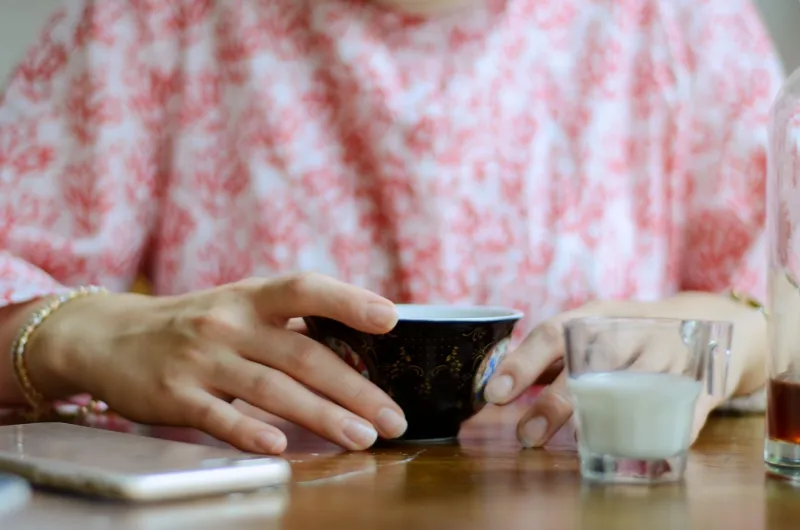
You ordered the same thing you always order. The same size, the same milk, the same number of pumps, the same everything. You have ordered this exact drink approximately four hundred and twelve times. You know this drink. This drink knows you.
And yet.
Something is off. You can't fully articulate it. You can't point to a specific flavor note or chemical compound. But somewhere between the first sip and the second, your brain has already flagged this situation as a Level Two Incident and begun assembling an investigative task force.
Congratulations. You are now three minutes into the most elaborate conspiracy theory you will construct all week.
Phase One: Immediate Denial
Your first instinct is to give it another chance. Maybe you imagined it. Maybe your mouth is just being weird. You take a second sip, longer this time, really committing to the analysis. You hold it in your mouth like a sommelier at a competition where the stakes are your entire morning.
Nope. Still off.
You take a third sip just to be sure, which accomplishes nothing except confirming that yes, something is different, and also now you have committed to finishing this drink regardless of your findings because you already paid for it.
Phase Two: Ruling Out the Obvious
You briefly consider the simplest explanation — that you just weren't fully awake when you tasted it, that your palate is unreliable before 9 a.m., that this is exactly the same coffee it always is and the problem is you.
You dismiss this immediately. The problem is not you. You are a reliable narrator.
So you move on to the real suspects. Did they change the beans? Entirely possible. Coffee suppliers do that. You've read about it. You don't remember where you read about it, but you definitely read something once that could be interpreted as relevant here. Did they get a new espresso machine? You glance at the counter. It looks the same, but machines can be recalibrated. They could have recalibrated it last night. You wouldn't know.
Did they hire someone new? You try to remember if the person who made your drink today was the same person who usually makes your drink. You are not entirely sure. You never really looked. This now feels like a significant oversight on your part.
Phase Three: The Investigation Expands
By the time you reach your car, you have developed three separate theories, each more detailed than the last.
Theory One: The milk ratio is slightly different. Not by much. Maybe by four percent. But you have a sensitive palate and four percent is enough.
Theory Two: The syrup pump is running low and the last few pumps deliver a slightly weaker concentration. This is a documented phenomenon that you are mostly making up right now but it sounds very plausible.
Theory Three: The coffee shop has quietly reformulated their entire recipe and hasn't told anyone because they're hoping customers won't notice. You noticed. You are the only one who noticed. This is both vindicating and deeply troubling.
You consider leaving a review. Not a bad review — you're not a monster — but a thoughtful, concerned review. The kind that says I've been a loyal customer for years and I just want to flag that something seems different. You start composing it in your head. You decide the opening sentence needs work.
Phase Four: Consulting Outside Sources
You text your friend who also goes to this coffee shop. You ask if their drink tasted weird recently. They say no. You ask when they last went. They say Tuesday. You note that Tuesday was before today, which means their data is outdated and therefore inconclusive.
You Google "can coffee beans change flavor between batches." The answer is yes. You feel vindicated. You screenshot the article even though you will never look at it again.
You consider going back tomorrow and ordering again, purely as a control experiment. You will take notes. You will be objective. You will approach this with scientific rigor.
Phase Five: Reluctant Acceptance
Sometime around 11 a.m., about two hours after the incident, a small quiet voice in the back of your mind suggests that maybe — just maybe — you brushed your teeth with a different toothpaste this morning and it slightly altered your perception of flavor for the first hour of the day.
You close all your open browser tabs.
You decide not to mention it to anyone else.
You make a mental note to order again tomorrow and see what happens, because the investigation is technically still open, and you are not the kind of person who leaves things unresolved.
The coffee was probably fine. The coffee was almost certainly fine. But probably and almost certainly are not the same as definitely, and until you have definitive proof, this case remains active.
Same time tomorrow. You'll be ready.