The Live Director's Commentary Running Nonstop During Your Own Zoom Call
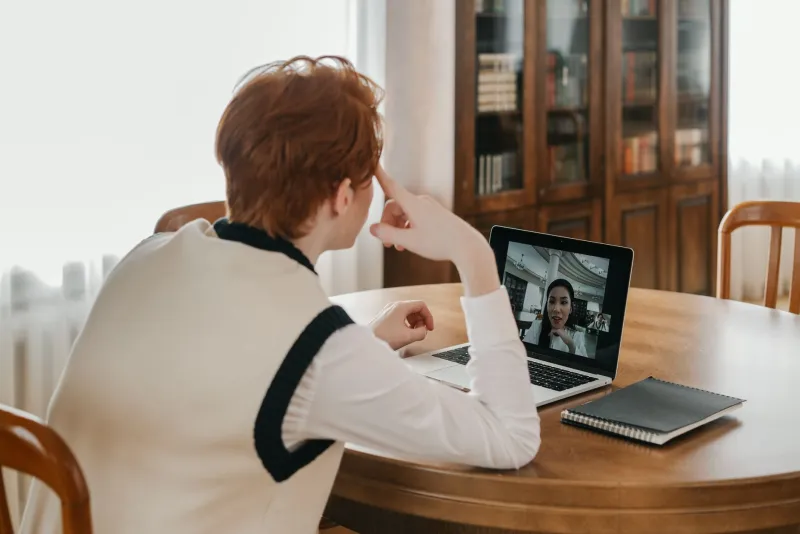
The call starts at 10:00 AM.
By 10:00:14, you have already assessed your lighting, noticed a shadow on the wall behind you that wasn't there last week, decided your background looks slightly unprofessional, decided it actually looks fine, and touched your face once.
By 10:00:30, you have touched your face twice more and are now actively trying to stop touching your face, which is making you think about your face constantly, which is making you touch it again.
The meeting has not technically started yet. Someone is still getting their audio to work.
The Opening Act
There is a version of you that is present in this meeting. That version is nodding, making appropriate eye contact with the camera (not the faces on screen, the camera, you know this, you've been doing this for years), and responding to things people say with the kind of measured, thoughtful reactions that suggest engagement.
Then there is the version of you that is providing live commentary on all of it.
Why did you nod like that? That was too much nodding. You looked like a bobblehead. Okay, stop nodding. Now you look bored. Nod a little. There. Hold that.
The commentary never stops. It runs continuously underneath every word you say, every expression you make, every time you glance at your own face in the little thumbnail in the corner — which you keep telling yourself to stop doing and keep doing anyway, because that thumbnail is right there and it is impossible to ignore.
You are simultaneously the actor and the extremely critical audience member, and neither one of them is fully paying attention to the meeting.
The Lighting Situation
Somewhere around the fifteen-minute mark, you notice the light has shifted.
This happens every time. The sun moves, or a cloud passes, or the lamp behind you does something mysterious, and suddenly you look like you are being interviewed in a documentary about financial crimes. Half your face is in shadow. The other half is weirdly bright. You look like a person who has something to hide.
You cannot adjust the lamp without visibly reaching off-screen in a way that will make everyone watch you. You cannot move your chair without the camera angle changing dramatically. You sit very still and hope the shadow resolves itself.
The shadow does not resolve itself.
You spend the next eight minutes of a quarterly review discussion thinking primarily about the shadow.
The Sound Check That Never Ends
At some point, you say something. You say it clearly, at a normal volume, into a microphone that is definitely working.
Someone says, "Sorry, you broke up for a second."
You have not broken up. Your connection is fine. But now you are going to repeat everything you just said with 40% more enunciation, speaking the way people speak when they are trying to be understood in a very loud restaurant, which on camera makes you look slightly unhinged.
The internal commentary is having a field day.
You are over-enunciating. You sound like you're doing a public service announcement. Dial it back. No, not that much. Why are you whispering now?
You find a middle register. You continue. You touch your face.
The Mute Button Relationship
The mute button is the most powerful tool available to you in any video call, and your relationship with it is complicated.
When you are on mute, you are free. You can exhale. You can make a face. You can say something under your breath that would absolutely derail the meeting if anyone heard it. The mute button is a confessional, a pressure valve, a small rectangle of privacy in an otherwise fully observed experience.
When you forget you are on mute and start talking, you experience a very specific kind of humiliation that has no name yet but probably should.
When you think you are on mute but are not, you experience something that doesn't have a name either, but that name would be much worse.
You check the mute icon approximately every ninety seconds. Just to be sure.
The Closing Ceremony
The meeting ends. Someone says "alright, I think that covers it" and there is a brief moment of collective relief before the small talk begins, which is somehow more exhausting than the meeting itself.
You say your goodbyes. You do the thing where you hover over the Leave button while still smiling, because you don't want to be the first to leave but you also don't want to be the last, and then you click it and the faces disappear and you are alone in your home office with a shadow on the wall and a face you have touched eleven times.
You sit for a moment in the silence.
You open your laptop and join the next call.
The commentary resumes immediately.
Okay, your hair looks fine. The lighting is slightly better. Stop touching your face. You're already touching your face.
You nod. You smile. You are present and engaged.
You are absolutely not thinking about the shadow.